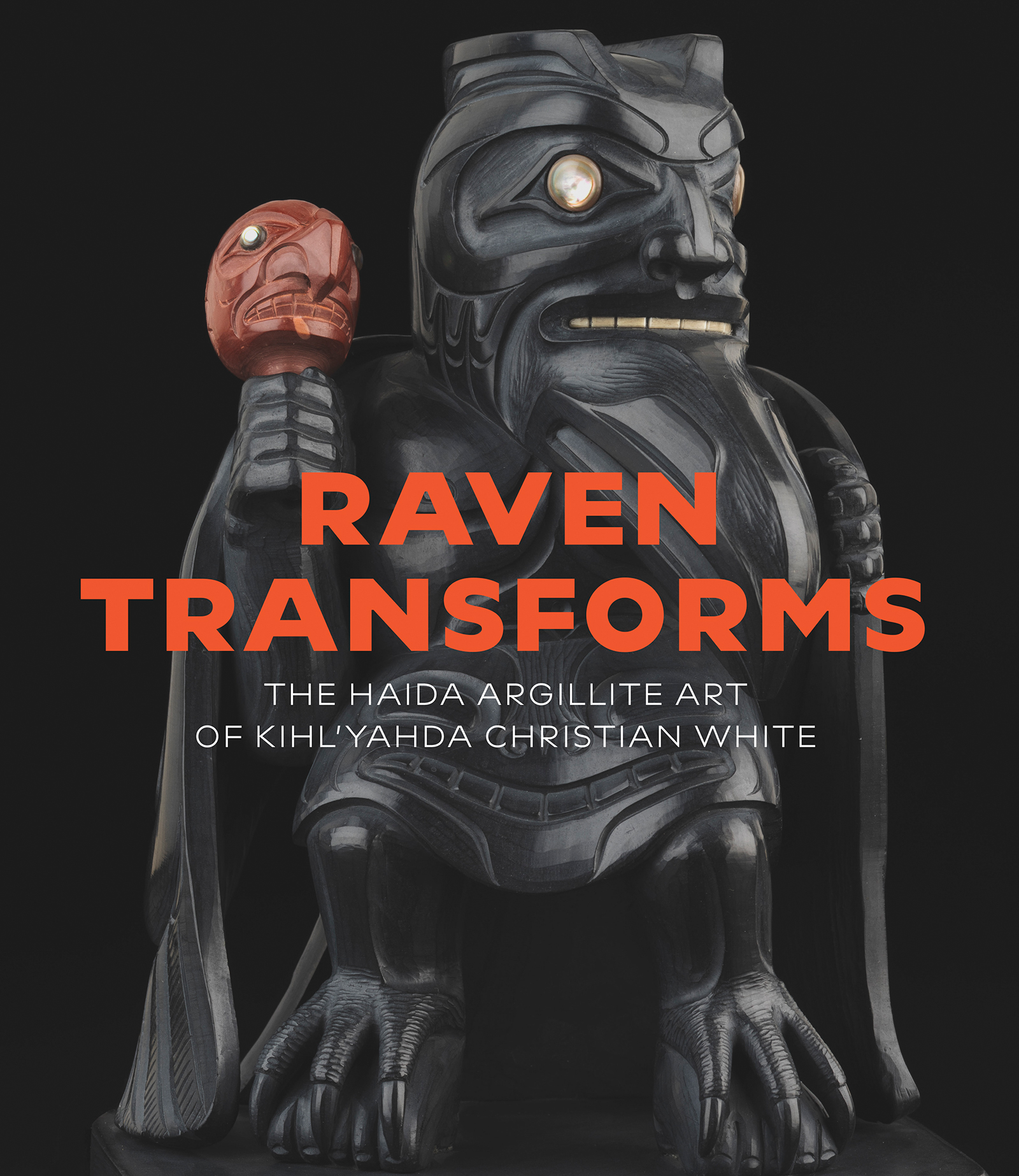
This first-ever monograph of a Haida argillite carver features nearly 200 artworks by Kihl’yahda Christian White, most never seen in public before, along with the artist’s telling of the supernatural stories that inspired them.
Kihl’yahda Christian White is often described by his peers as a “natural-born carver.” Since first picking up a knife as a teenager five decades ago, he has become one of the most accomplished artists on the Northwest Coast and a fierce advocate of Haida culture. At home in Haida Gwaii, he is known for monumental cedar poles, longhouses, and canoes that bring the entire community together in celebration.
Beyond Haida Gwaii, he is best known for intricate carvings in argillite, or “black shale,” the fine-grained stone found only on Haida Gwaii, its use strictly regulated by the Haida Nation. Since artists first started carving argillite to trade with Europeans around 1800 such works have served as emissaries for Haida culture, a practice that White continues today—his exquisite works with their dazzling inlays of abalone shell and mastodon ivory are highly sought-after by devoted patrons around the world.
The consistent demand for White’s argillite work means it rarely enters the public view. For this publication, several major private collections in Canada and the U.S. were newly photographed so the works can be seen beyond their homes for the first time. Gary Wyatt, White’s longtime gallerist, interviewed the artist at length to inform his sketch of a life devoted to art and community. In her foreword Karen Duffek reflects on the “two worlds” that his practices inhabit. And White himself shares two dozen traditional Haida stories that appear alongside his works, tales of Travelling Raven, Sea Grizzly, Volcano Woman, Lazy Son-in-Law, and more—the supernatural beings whose deeds shaped the Haida world, and whose unique forms are captured with brilliant elegance in White’s extraordinary work.
Author
Gary Wyatt represented master-level Northwest Coast, Inuit, and Maori artists for thirty-five years, including Robert Davidson from the late 1980s to 2020. He was curator of Northwest Coast Art for the Inuit Gallery of Vancouver for eight years, and co-founded the Spirit Wrestler Gallery in 1995. He has curated many ground-breaking exhibitions of contemporary Northwest Coast art, lectured extensively on the art form internationally, and authored several catalogues and books, including Susan Point: Works on Paper (2014), Seekers and Travellers: Contemporary Art of the Pacific Northwest Coast (2012), and Mythic Beings: Spirit Art of the Northwest Coast (1999).
More About Gary Wyatt
Kihl’yahda Christian White has been a working Haida artist for the past five decades and is widely acknowledged as a master carver. His practice comprises sculptural works in argillite and other materials, as well as monumental cedar works such as totem poles and canoes. As the founder of the Tluu X̱aada Naay (Canoe People’s House) Society, a group of artisans committed to preserving and enhancing Haida culture, he is very active in the Haida community: hosting and participating in ceremonies and Potlatches, including many held at his Tluu X̱aada Naay Longhouse; serving on cultural and repatriation committees; and sharing his knowledge and skills through the mentorship of young Haida artists. In 2007, he received the inaugural Fulmer Award in First Nations Art from the B.C. Creative Achievement Foundation, and in 2023, he and Candace Weir-White received a B.C. Achievement Foundation Community Award for their work as cultural leaders, language carriers, mentors, and community ambassadors. He lives in G̱aw Tlagée, Haida Gwaii.
More About Kihl’yahda Christian White
Karen Duffek is Curator Emerita and an Honorary Associate with the Museum of Anthropology at UBC (MOA) and an independent curator, writer, and editor. As Curator of Contemporary Visual Arts and Pacific Northwest at MOA from 2000 to 2025, she supported the activation of Northwest Coast Indigenous collections inside and outside the museum, and her research, exhibitions, and publications focused on the relationships between historical and contemporary art practices, museum collections, communities, and art markets. She is the author and co-author of many books, including most recently Where the Power Is: Indigenous Perspectives on Northwest Coast Art (with Bill McLennan and Jordan Wilson; Figure 1 Publishing, 2021).
More About Karen Duffek